Which AI tools earn their keep in a small business
A hype free guide to where AI genuinely helps a small business and where it burns money. Covers drafting, summarizing long documents, answering questions against your own files, data cleanup, the work that still needs a human signature, and how to test whether a subscription is earning its keep.
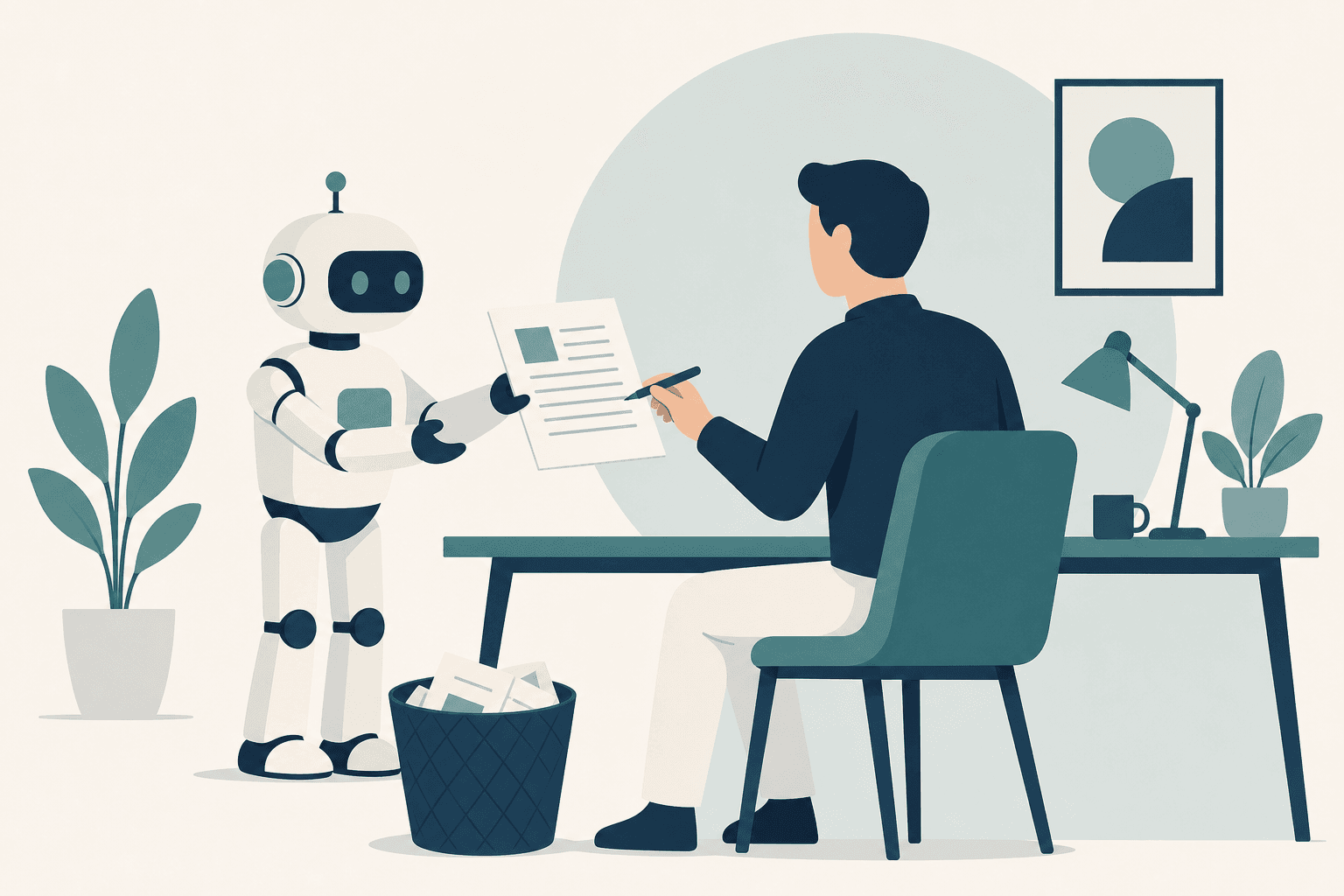
The AI tools for small business that earn their keep do one of four jobs: draft text a person then edits, summarize long documents, answer questions against your own files, and clean up messy data. Everything else is usually a subscription you forget to cancel. The rule that keeps this honest is simple. AI drafts, a human signs.
The short version:
- AI is strong on first drafts and weak on final answers.
- A subscription pays off when it replaces a task you repeat every week, not one you did once.
- Anything a customer will read should be read by a person first.
- Asking questions against your own documents is one of the more commonly overlooked uses in a small shop.
- A tool bought because a competitor mentioned it usually goes unopened.
What does AI actually do well in a small business?
Four jobs, and they are narrower than the marketing suggests.
Drafting is the obvious one. A follow-up to a quote that has gone quiet, a job description, a page of copy for a service you have never described in writing, the email you have been putting off since Tuesday. The blank page is the expensive part, and AI removes it in seconds. What comes back has the right shape and the wrong details, which is what a rough draft is.
Summarizing is the quietest win. Feed it a long insurance policy, a supplier contract, or an email thread that grew twelve replies while you were on a roof. You get the gist plus a list of things to go check. You still read the clauses that carry money or liability yourself, because a summary that drops one sentence about payment terms costs more than it saved.
Answering questions against your own documents is the capability that most often goes unused in a small shop. Load your warranty language, your standard scope, your pricing sheet, your employee handbook. Then ask plain questions the way a new hire would. It turns a folder nobody opens into something that answers back, and it only works when the documents are current.
Cleaning up messy data is the fourth. Customer names typed six ways, addresses missing ZIP codes, a spreadsheet exported from a system nobody supports anymore. AI is good at proposing one consistent format across thousands of rows. It is not good at knowing that two similar records are the same customer, so verify a sample before anything gets written back. When the mess keeps coming back, the durable fix is usually changing how data moves between your systems rather than a monthly tool.
Which AI tasks are worth paying for?
Judge a tool by the task it replaces, not by the category on its pricing page. Here is how the common jobs sort out.
| Task | How much AI helps | What a person still has to do |
|---|---|---|
| First draft of an email, quote note, or web page | A lot | Rewrite anything stating a fact, a price, or a promise |
| Summarizing a long contract, policy, or thread | A lot | Read the sections that carry money or liability |
| Answering questions from your own documents | A lot, once the documents are loaded | Spot check answers against the source file |
| Standardizing a messy spreadsheet | A lot on formatting, little on judgment | Verify a sample before the data is used |
| Replying to customers with no review | Costs more than it saves | Read and send it yourself |
The pattern holds almost everywhere. Where a mistake is cheap and obvious, AI is worth paying for. Where a mistake is expensive and quiet, a person has to sign.
Where does the money get burned?
Three places, and they look different on the invoice than they do from the outside.
Autopilot customer replies are the first. A bot that answers with total confidence and gets one detail wrong does not fail loudly. It fails by quoting a policy you do not have, promising something you cannot do, or sounding like a stranger to a customer who chose you because you are not one. The damage surfaces later as a dispute or a review, long after anyone connects it to the tool.
Anything published unread is the second. Text sent straight to a website, a proposal, or a set of terms will eventually include a claim you cannot back. It might invent a certification, restate a warranty incorrectly, or describe a Pennsylvania home improvement contractor registration as a license, which is a different thing with a different meaning. Your name is on the page. The tool's name is not.
Fear of missing out is the third. Seats bought for a team that never opened the app, a specialized platform for a task that comes up twice a year, a subscription started because someone at a trade show mentioned it. If you cannot name the task it removed from a specific person's week, it is not earning anything.
How do you tell whether a tool is earning its keep?
Run a short, boring test before the trial ends. Name one task you do at least weekly, and time it honestly once without the tool. Then use the tool for two weeks and watch whether the time actually drops, whether the output needs less rework, and whether you keep reaching for it when nobody is watching. If any of those comes back no, cancel while cancelling is still easy.
Watch the hidden cost too. A tool that saves twenty minutes of writing but adds thirty minutes of checking has moved work rather than removed it. That trade is fine when checking is easier than writing.
Where does AI fit with the software you already run?
Mostly at the seams, and only after the underlying process is organized. AI works well on top of clean, structured information and poorly on top of a shared drive nobody has sorted since 2019. If your quotes, jobs, and customer records live in one spreadsheet that three people edit at once, the higher return is usually replacing that spreadsheet with a small purpose built tool first. Once the data is in order, AI has something worth searching.
The same logic applies to public facing work. AI can help draft the words, but a site still needs structure, speed, and pages built around what people actually search for. Plenty of shops get more from one well organized internal tool for scheduling or intake than from any AI subscription.
Common questions
Does a small business need a paid AI subscription at all?
Not necessarily. Free tiers handle drafting and summarizing well enough for occasional use, and many businesses never outgrow them. Paid plans start to make sense when you want your own documents searchable, need to keep work out of consumer data policies, or have several people using it daily.
Can AI write your website copy?
It can write the first draft, and that draft should not go live untouched. AI produces generic sentences by default, and generic copy is what makes a small business site interchangeable with every competitor. Use it to break the blank page, then rewrite in your own words with real specifics about the work. If the site itself needs rebuilding, that is a separate project from the words.
Is it safe to put customer information into an AI tool?
That depends on the plan you are on, so read its terms rather than assuming. Business and enterprise plans commonly state that customer inputs are not used to train models, while free consumer tiers often reserve broader rights. As a default, keep out anything you would not email to a vendor: full payment details, sensitive personal records, and anything covered by a confidentiality agreement.
What about an AI chatbot on your website?
Treat it as a search box, not a salesperson. A chatbot restricted to answering from your own published pages is genuinely useful and hard to embarrass. One that improvises about pricing, scope, timelines, or legal terms can create expectations you never agreed to, and sorting that out afterward falls to you.
How long does it take to get useful at this?
An afternoon for drafting and summarizing, longer for the document and data work. The skill that matters is not prompt writing. It is knowing which parts of the output to distrust, and that comes from checking the first several results yourself.
Need this kind of work for your organization?